
- The typical household can save thousands in interest by making just one additional monthly payment annually
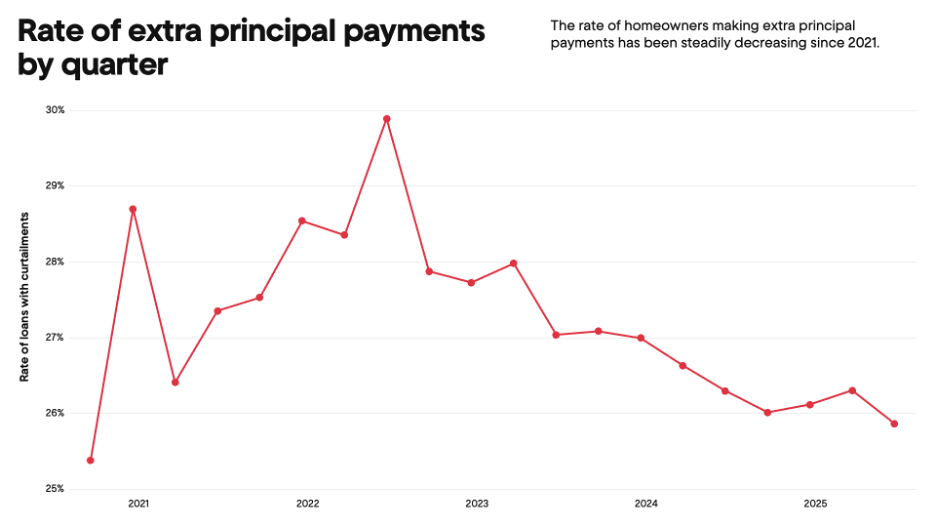
- Extra payments are most commonly made by homeowners who locked in ultra-low rates in 2020 through 2022
- Those who make larger principal payments are most likely to do so shortly after their loan originates, suggesting some homeowners are most motivated to pay down their mortgage early in the term
For many Americans, a key financial health goal is reducing their debt as quickly as possible – and homeowners are no exception. Rocket Mortgage data shows that roughly one in four clients make at least one additional principal payment each year. Among those who do, average contributions add up to the equivalent of one extra monthly mortgage payment annually.
While making 13 mortgage payments each year may not seem like much, the strategy can have a meaningful impact over the life of the loan, shortening some homeowners’ payoff timeline by nearly six years.
This analysis is based on a review of additional principal payments made by Rocket Mortgage clients between January 2021 and January 2026.
Assuming an interest rate of 6.67% – the weekly average as of August 13 – a homeowner with a newly originated 30-year fixed mortgage at the median loan amount at Rocket Mortgage of $221,977 could save approximately $68,000 in interest and pay off their loan nearly six years early if they made the equivalent of just one extra monthly payment each year, assuming their monthly principal and interest payment is roughly $1,425 (excluding taxes and insurance).
The same homeowner could pay off their loan 10 years early by making slightly more than two additional monthly payments annually.
“For homeowners who have room in their budget and want to reduce debt, small additional principal payments can have a surprisingly meaningful impact over time,” said Bill Banfield, Chief Business Officer at Rocket Mortgage. “One simple approach is making the equivalent of one extra payment each year. On a 30-year mortgage, that can eliminate years of payments and save tens of thousands of dollars in interest.”
Switching from monthly to biweekly payments is a habit that effectively makes the equivalent of 13 monthly payments instead of 12. Contributing the full amount of that extra payment toward the principal balance reduces interest costs and shortens the life of the loan.
Those With Lower Mortgage Rates Are More Likely to Make Extra Payments
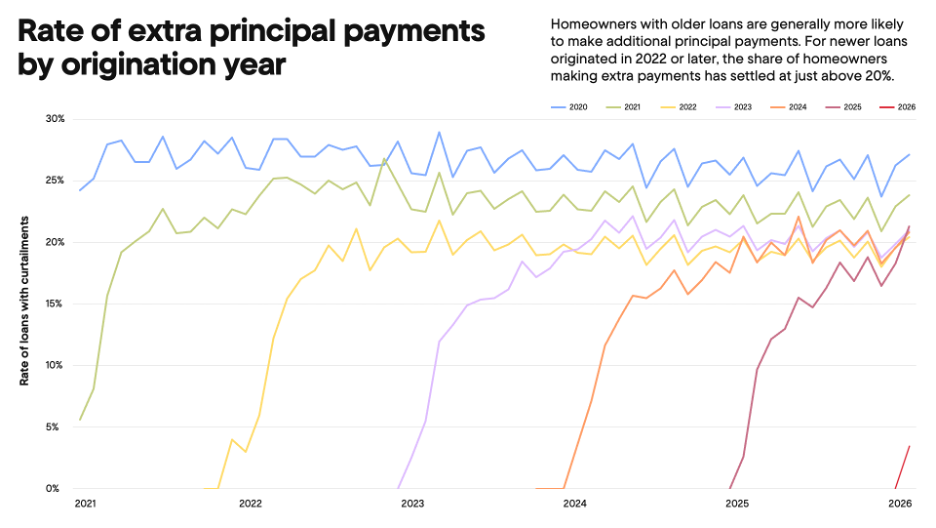
Homeowners who locked in ultra-low mortgage rates during 2020 through 2022 are more likely to make extra principal payments than those who bought after rates climbed.
That may seem counterintuitive, since a loan of 3% falls at or around the current inflation rate. Homeowners with higher interest rates have the most to save by paying down their mortgage early because every extra dollar reduces future interest costs. However, homeowners with lower mortgage rates typically have smaller required monthly payments, leaving more room in their budgets to send additional money toward their loan balance.
Those with higher-rate mortgages, on the other hand, often face larger monthly housing costs alongside rising everyday expenses, making it more difficult to consistently pay beyond the minimum, even though doing so could save them money over the life of the loan.
While homeowners with higher mortgage rates are less likely to make additional principal payments overall, those who do tend to make larger contributions.
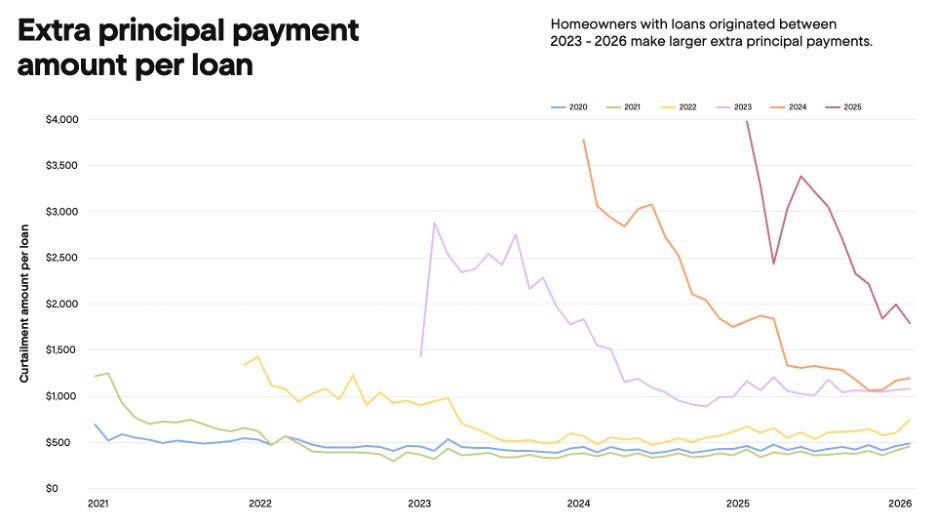
The homeowners who do make further principal payments tend to take different approaches depending on when they bought their home. Those who purchased during the higher-rate environment of 2023 through 2025 generally make fewer extra payments. When they do, though, those payments are often much larger than those made by homeowners who locked in historically low mortgage rates from 2020 through 2022.
Those larger payments are most common shortly after a mortgage is originated and become less frequent over time.
“Our research found that homeowners who choose to make larger principal payments tend to do so earlier in the life of the loan,” said Banfield. “This pattern includes those with ultra-low rates, suggesting the beginning of a mortgage may be an important moment when they are particularly focused on reducing debt and building equity.”
The Bottom Line
A mortgage is often the largest financial commitment a person will make, but paying it off sooner doesn’t necessarily require a dramatic change in lifestyle. For homeowners with room in their budget, small, intentional habits – like switching to biweekly payments or putting bonuses, tax refunds or other unexpected income toward the principal – can add up over time.
Some lenders make it easy for homeowners to put extra money toward their principal. Rocket Mortgage offers a calculator that shows how much an additional payment could save over the life of the loan, along with flexible options for choosing a payment cadence that works best for the homeowner, including the popular biweekly option.
While those optional payments may seem modest in the moment, they can ultimately reduce interest costs, shorten the life of the loan and increase homeowner equity.
Methodology
This analysis is based on a Rocket Mortgage review of curtailment payments made by its mortgage clients. A curtailment is defined as an additional payment applied directly toward a loan’s principal balance beyond the scheduled monthly mortgage payment. The incidence analysis includes all eligible serviced loans. Analyses of payment size and timing are limited to loans with at least one curtailment payment.
The analysis examined client payment behavior from January 31, 2021, through January 31, 2026, and includes loans that were serviced at any point after January 1, 2021. Results reflect observed trends in voluntary extra principal payments made by Rocket Mortgage clients during the study period.
Mortgage lending products and mortgage related information provided by Rocket Mortgage, LLC; NMLS #3030; www.NMLSConsumerAccess.org. Licensed in 50 states.